

The Summer Bridge to A-Level Mathematics
A four-week programme preparing Year 11 students for the A-Level Transition Test
Former Head of Mathematics | Active A-Level Examiner | Taught Students from Eton, Westminster, Brighton College & Other Leading Schools
Rated 5 stars on Trustpilot — 30+ independent parent reviews ★★★★★
Join the Waitlist

For Year 11 students with predicted Grade 8 or 9 in GCSE Mathematics. Mondays 7:00–7:50pm, 27 July – 24 August 2026. Capped at 10 students.
(You are not committing yourself. Waiting list members receive first refusal 48 hours before public enrolment opens).
Message me on WhatsAppA Grade 7 at GCSE Doesn't Always Mean Your Child Can Do Grade 7 Topics
This is one of the least-understood things about how GCSE Mathematics is graded — and it catches even the most engaged parents off guard.
Here's how the marking works. A student can achieve a Grade 7 in GCSE Maths without a secure understanding of Grade 7 material itself. If they get every Grade 6 and below question right and pick up a few method marks from Grade 7 and above questions, they accumulate enough marks to land on a Grade 7. The same applies to Grades 8 and 9: strong performance on the easier material can mask real gaps at the harder end.
This is not a failure on your child's part. It is the structure of how the exam is built. Many capable, hard-working students leave Year 11 with a Grade 7, 8, or 9 — and an honest gap in their knowledge of the algebra that A-Level Mathematics treats as the absolute foundation: surds, indices, manipulation of complex expressions, completing the square, the discriminant, graph transformations.
That gap doesn't surface during Year 11. It doesn't surface over the summer.
It surfaces in the first weeks of Year 12, when the schools that take this transition seriously administer something called a Transition Test.

The Transition Test Explained
Many of the UK's leading independent and academically selective schools administer a short test in the first two weeks of Year 12 A-Level Mathematics. Its purpose is to assess whether each student has the genuine algebraic foundation needed to succeed in the course. Schools use different formats, but the test typically covers core Year 11 topics — the same ones above — and is marked rigorously.
Students who fail the Transition Test are usually not permitted to continue with A-Level Mathematics at their school. They are asked to choose another subject within the first half-term.
This sounds severe, and at first hearing it can feel alarming. But it is genuinely the right system — for the school and for the student.
For the school: there is no benefit in enrolling students on a course they have no realistic prospect of passing. It harms the school's published results, and consumes teaching resources better spent elsewhere.
For the student: it is far better to find out in mid-September of Year 12 that A-Level Mathematics isn't the right choice — when there is still time to switch to a subject where they can succeed and thrive — than to discover the same truth eighteen months later, in the middle of their A-Level exams.
The Transition Test, in other words, is a kindness. It catches the mismatch early.
The problem is not the test itself. The problem is that capable, hard-working students with strong GCSE grades can be caught by the test simply because their school covered too much, too fast, in Year 11 — and the foundational algebra was never fully embedded.
These are not students who shouldn't be doing A-Level Mathematics. They are students who arrived in Year 12 with a fixable gap, and were told "you're done, change subjects" before they had the chance to fill it.
This is the gap the Summer Bridge programme is designed to close.

Personally guided, never lost
Every session delivered by me directly to a group of no more than ten students. Real questions get real answers. Real misunderstandings get caught and addressed before they harden into gaps.

Confident from day one of Year 12
Your child arrives at A-Level Mathematics fluent in the foundations the course assumes — confident in surds, indices, completing the square, graph transformations. The first months of A-Level feel like familiar territory, not uphill catch-up.
The Summer Bridge to A-Level Mathematics
A four-week programme building the foundations strong GCSE students need.
The Summer Bridge is a focused, four-week intensive designed for one specific audience: Year 11 students with predicted Grade 8 or 9 in GCSE Mathematics, about to embark on A-Level Maths in September.
Its purpose is straightforward. By the end of four weeks, your child will be fluent in the foundational algebra that A-Level Mathematics treats as essential — confident in surds, indices, completing the square, the quadratic formula, the role of the discriminant, graph transformations, and curve sketching. The same topics that determine whether a student passes a Transition Test. The same topics that determine whether the first term of A-Level Maths feels comfortable or overwhelming.
What I tell parents at the end of each bridge cohort is this. Students who arrive in Year 12 with these foundations genuinely solid tell me, every year, that A-Level Mathematics feels like their most comfortable subject. Not because the material is easy — it isn't — but because the first few months of A-Level Maths are essentially a recap and modest extension of these same topics. A student who has them at fluent recall level finds the early A-Level content reassuring rather than overwhelming, builds confidence early, and is positioned to handle the genuinely new Year 12 material — calculus, more advanced trigonometry, mechanics, statistics — from a place of academic security rather than playing catch-up.
That is what this programme delivers.
It is not remedial. It is not for students who need to scrape into A-Level Maths. It is for ambitious students who deserve a smooth, confident start — and for parents who would rather invest four weeks in summer than discover a gap in September.

A Sklinitzis
“Lee is a great tutor. He demonstrates a passion for his subject and has an engaging teaching style. Through a combination of group teaching and one to one sessions Lee supported two of my sons to achieve very high grades at A Level. Both were predicted C grades to start with, and finished up significantly better. The sessions are organised and time is managed well to deliver results. Both sons have gone on to secure their first choice at University. The proof is in the results. Difficult maths is conveyed clearly and simply and the boys seemed to progress quickly. Lee is a master class in how to deliver online tuition.”

The Four Lessons Your Child Will Master
Each lesson runs for 50 minutes live, with an A-Level-standard worksheet (with fully worked solutions) for practice between sessions and a short diagnostic quiz at the end of each week. Every lesson is recorded and uploaded to your portal afterwards, so material can be revisited as often as needed.
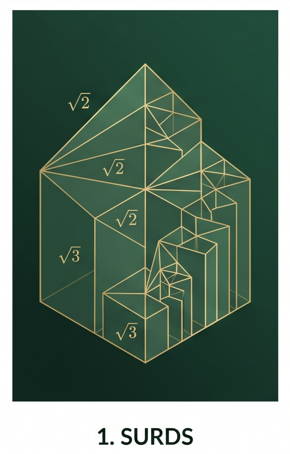
Lesson 1 — Surds (including Rationalising)
Surds appear in virtually every A-Level Mathematics paper, but many GCSE students leave Year 11 able to recognise them without being able to manipulate them fluently. This lesson covers simplification, the four operations on surds, and — critically — rationalising both single-term and binomial denominators. By the end, your child will handle surds with the speed and confidence that A-Level expects rather than the cautious uncertainty that GCSE often leaves behind.
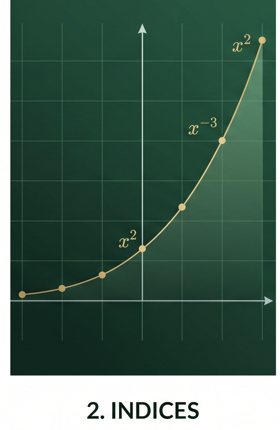
Lesson 2 — Indices
Index laws appear deceptively simple at GCSE, but A-Level demands fluent manipulation of fractional and negative indices in complex expressions. This lesson covers all index laws systematically, then progresses to manipulating expressions with fractional and negative powers, and finally to solving equations where the index itself is the unknown. By the end, your child will be confident with the kind of index manipulation that becomes essential the moment differentiation and integration arrive in Year 12.
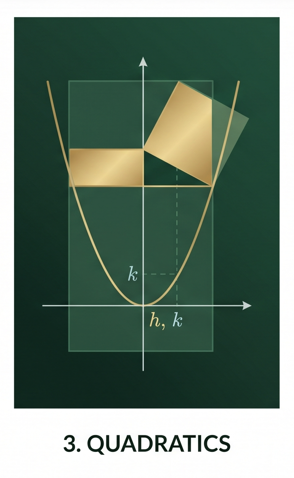
Lesson 3 — Completing the Square and Quadratics
This is where A-Level Mathematics really begins. The lesson covers the quadratic formula, the technique of completing the square, the role of the discriminant in determining the nature of a quadratic's roots, and how completed-square form reveals the geometry of a parabola at a glance. By the end, your child will see quadratics not as a topic to be memorised but as a tool to be wielded — exactly as A-Level Mathematics requires.
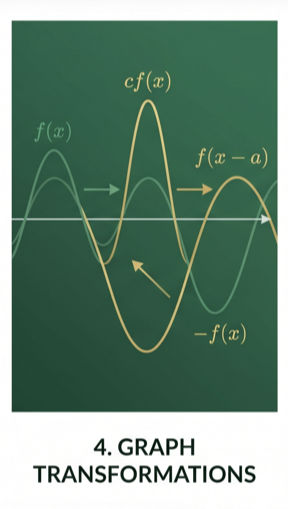
Lesson 4 — Graph Transformations and Curve Sketching
A-Level Mathematics rewards students who can think visually as well as algebraically. This lesson covers the four types of graph transformation — translations, stretches, reflections, and their combinations — and how to sketch cubic, quartic, and reciprocal graphs confidently. By the end, your child will be able to look at a function and see what its graph looks like, and predict how that graph behaves under any transformation. This visual fluency makes calculus, modelling, and trigonometry significantly easier when they arrive.
G Fernandes
“Mr Guffick was very supportive and developed my sons math skills in a way that will stand in good stead through university and later in life. My sons confidence in approaching and solving hard math problems improved significantly, resulting in an A* in math and an A is further math, which is an excellent result.
We are grateful to Mr Guffick for his guidance and mentoring throughout my sons 6th form.”
What's Included in the Programme
The Summer Bridge is built as a complete package. Every element serves the same outcome — your child arriving at Year 12 with the foundational algebra that A-Level Mathematics assumes.
1. Four 50-minute live lessons, capped at 10 students ✓
Taught personally by me on Monday evenings, 7:00–7:50pm UK time. Every session is recorded and uploaded to your child's portal for revision.
2. An A-Level-standard worksheet with fully worked solutions ✓
One per lesson. Designed to embed the content through targeted practice — and to give your child their first taste of working at A-Level standard rather than GCSE.
3. A weekly diagnostic quiz ✓
At the end of each week, identifying any remaining gaps and signposting precisely where to consolidate before the next lesson.
4. Curated YouTube playlists for further practice ✓
Drawn from my existing chaptered YouTube channel. Whatever topic your child wants more time on, additional material is one click away.
5. An endpoint assessment ✓
A final check at the close of the programme, providing both a benchmark for entering Year 12 and a tangible marker of progress.
6. Priority enrolment offer for the September Year 12 group ✓
Bridge participants receive first refusal of cohort places in my year-round Year 12 group programme, with founding member recognition — placed ahead of public enrolment.
A complete four-week programme — teaching, practice, diagnostics, and a clear pathway through to Year 12.
Dates, Times, and Format
The Summer Bridge runs across a five-week window in late July and August — four live teaching weeks with a built-in consolidation break in the middle.
✓ Four 50-minute live lessons, one per week
✓ Mondays, 7:00pm – 7:50pm UK time
✓ Delivered live online via Zoom
✓ All sessions recorded and uploaded to your child's portal
✓ Capped at 10 students — so every question gets answered and every misunderstanding gets noticed
----------------------------------------------------
Lesson 1: Surds (including Rationalising) — Monday 27 July 2026
Lesson 2: Indices — Monday 3 August 2026
Rest week (no lesson) — week of 10 August 2026
Lesson 3: Completing the Square and Quadratics — Monday 17 August 2026
Lesson 4: Graph Transformations and Curve Sketching — Monday 24 August 2026
The mid-programme break gives students a week to consolidate what they have learned before moving on — and accommodates families travelling in mid-August.

Lisa Diao
“Lee is a superb teacher! He prepares all his lessons ahead, had an abundant source of material and most I importantly cares about his students. My daughter received an A* for both maths and further maths.”
Investment
£295 for the complete programme
That covers the four live lessons, all four A-Level-standard worksheets with fully worked solutions, the weekly diagnostic quizzes, the endpoint assessment, access to the curated YouTube playlists, all session recordings on your child's portal, and the priority enrolment offer for the September Year 12 group programme.
For context: a single hour of standalone one-to-one A-Level Mathematics tuition with me typically costs £120. For under £300, the Summer Bridge delivers four weeks of structured group teaching, comprehensive practice material, diagnostic feedback, and a clear pathway through to the year-round Year 12 programme.
Your Year 11 Deserves to Start A-Level Maths Feeling Capable, Not Catching Up
The Summer Bridge runs once a year. Ten places. Four focused weeks. Foundations that decide whether September feels comfortable or overwhelming.
Free to join. No commitment. First refusal of places before public enrolment opens.
Join the Waiting ListHave a specific question first? Message me directly. I respond personally, usually within 24 hours.
Message me on WhatsApp
Meet Your Teacher
I'm Lee Guffick — a former Head of Mathematics at a leading independent school and an active Edexcel A-Level examiner. I'll be your child's tutor for every minute of the Summer Bridge programme.
I hold a Master of Arts (Distinction) in Educational Innovation with a Specialism in Mathematics from the University of Warwick. My fifteen-year classroom career has spanned both state and independent settings, with teaching observed during OFSTED Outstanding and ISI Excellent inspections. I am also a Hays Education Award winner and a Member of The Tutors' Association.
As an active A-Level Mathematics examiner, I mark exam scripts every summer. That work means I see the same gaps come up year after year — and that observation directly shapes how I teach precision in my own students.
I have taught students from schools including Eton College, Westminster School, Brighton College, Dulwich College, and Wycombe Abbey.
Every session of the Summer Bridge is delivered by me personally. No replacement tutors. No junior staff. The parent who enrols their child is buying my time and attention for four weeks — directly.
I am an active teacher at a leading independent school in the West Midlands and I am fully DBS-checked. Nothing makes me happier than seeing a young person who once said "I'm just not good at maths" go on to ace their A-Level exams.
Amanda
“Guffick Maths has been brilliant for our son's A-level maths. He joined the Year 13 group lessons and also has 1:1 sessions to catch up on the specific gaps in his knowledge. In only 3 months, Lee has boosted his confidence hugely and therefore his predicted grade has gone from a D to a B, with getting an A in the summer exams, a real prospect if this trajectory continues. Thank you, Lee. You are a star!”
Ethan
“I had Lee for 3 years through Year 11 to Year 13 and he has been a major help from improving my Maths ability. He helped build my confidence in a relaxed and collaborative environment with the sessions being led mostly by what I wanted to cover. I felt I could ask any questions no matter how trivial or silly they initially seemed and I was always met with an insightful and tailored response to my exact issue. Lee is punctual and very reliable with no last minute cancellations. He gives suggested work to complete between sessions aimed at your weaker areas so be prepared to put the work in to make the most of this incredible tutor. He helped me get an A* in Maths and aided me in getting into my chosen university.”
Sue
"My son had Lee as a Maths tutor for part of Year 13, these are his words:
"Lee is an amazing tutor, as someone who had missed a large amount of time in school, I had lost confidence in my Maths but every time I had a session with Lee, either in a group or a one-to-one call, I always left the session feeling more confident. My grades improved dramatically whilst I was with Lee; his teaching style was always helpful and tested my understanding of topics across the Maths syllabus, but I never felt under unfair pressure if asked a question. Lee always checked if everyone was OK with the questions we did and if someone had made a mistake, he would talk with them directly to make sure they fully understood the correct method to use"
As his Mum I would add that I wish I'd got Lee onboard sooner. My son often said that Lee explained things in a way that other teachers hadn't and there were very many lightbulb moments. My son has gone from struggling with A Level Maths to loving it."
Common Questions
A few questions parents typically ask before booking. If yours isn't covered, please get in touch.
Q1 — What if my child has already booked summer travel during one of these weeks?
Q2 — What happens if my child doesn't achieve the GCSE grade to do A-Level Maths?
Q3 — How does the bridge connect to your September Year 12 group programme?
Q4 — My child is doing AQA or OCR, not Edexcel. Does that matter?
Q5 — Is my child the right fit if they're targeting Grade 7 rather than 8/9?
Q6 — What happens after the four weeks?
Q7 — Can my child do the bridge as well as a holiday tutor or one-to-one sessions?
Join the Waiting List
The Summer Bridge is capped at ten students. Waiting list members receive first refusal of these places. The priority enrolment offer arrives in your inbox 48 hours before public enrolment opens — so you can decide at your own pace, knowing your place is held while you do.
Joining the waiting list is not a commitment. It costs nothing. It simply secures your child's right of first refusal — and ensures that, when enrolment opens, you are at the front of the queue rather than competing for one of the remaining places (if any).
Your Year 11 Deserves to Start A-Level Maths Feeling Capable, Not Catching Up
The Summer Bridge runs once a year. Ten places. Four focused weeks. Foundations that decide whether September feels comfortable or overwhelming.