
Starting Year 13?
This Is the Year That Decides the Grade.
Former Head of Maths | Taught Students from Eton, Westminster & Other Leading Schools | Active A-Level Examiner
Rated 5 stars on Trustpilot — 30+ independent parent reviews ★★★★★
Year 13 covers as much content as Year 12 — in two terms instead of three. And this autumn, your child's school will set the predicted grades that go on their UCAS application. The good news is that starting September ahead — not recovering in January — changes everything.
Message me on WhatsAppHeading for a B When They're Capable of an A*? Here's How to Tell.
After a solid Year 12, it isn't always obvious from the outside. My free guide for parents of students entering Year 13 covers how predicted grades are set this autumn, the two topics that carry a disproportionate share of the final marks, and why the students who finish with the top grades are the ones who start September ahead — not the ones who catch up after mocks. No obligation, and it's yours in 30 seconds.
Email Me the Free Guide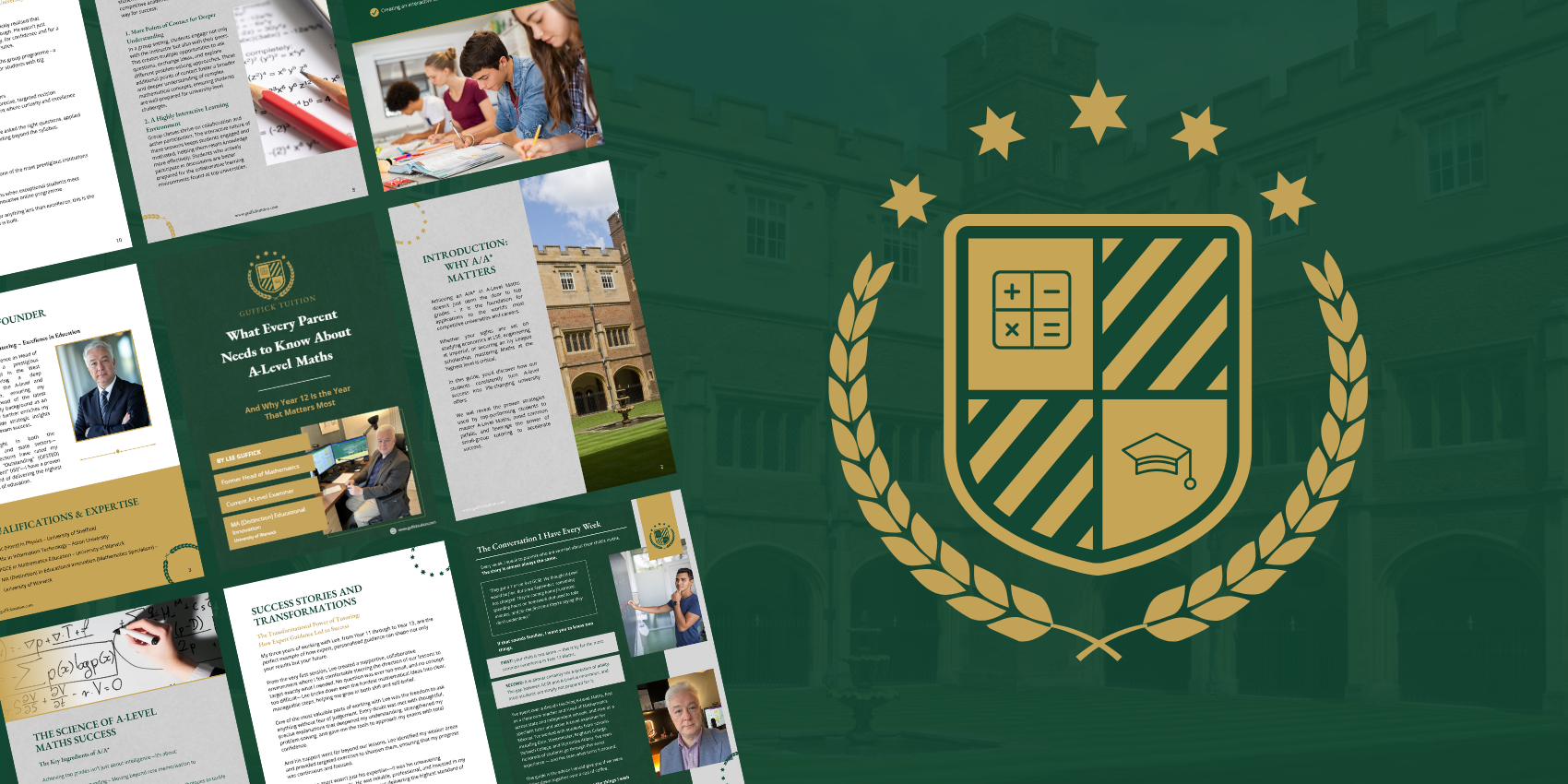


Why Year 13 Is Where the Final Grade Is Decided

Year 13 carries the same amount of content as Year 12 — in two terms, not three.
Schools are racing the calendar from the first week of September, and the pressure lands hardest on the most difficult material.
The topics that decide the top grades are often taught last. Differentiation and integration carry a disproportionate share of the marks on the final papers — yet many schools, following the textbook chapter order rather than the exam board's recommended teaching order, leave them until just before study leave.

These topics take months — and more than one pass — to truly master. Knowing when to use the reverse chain rule, or which integration technique fits which problem, rarely lands on first exposure. The students who sit the exam with confidence have met this material more than once.

Waiting for mock results to act builds in a disadvantage. By the time a January mock reveals the problem, the time to fix it comfortably has already gone. The students who do best are working ahead of the school's pace from September — not catching up after Christmas.
Why Getting Help Now Makes All the Difference

Every September, the same calls come in — parents of new Year 13 students, worried about predicted grades, asking whether there is time to turn things around. There is, if we start now. The first job is making sure the Year 12 topics that most often wobble — logarithms, optimisation, exponential modelling — are properly secured, so the autumn isn't spent looking backwards.

The students who do best in their final exams are almost always the ones who were ahead of the school's pace in the autumn of Year 13 — when predicted grades were being set, and there was still time to build real understanding rather than cram. Right now, your child has the whole of Year 13 in front of them. That is enough time to master the material that decides the top grades. By January, that window will be much smaller.
Our Structured Group Programme Built for
Year 13
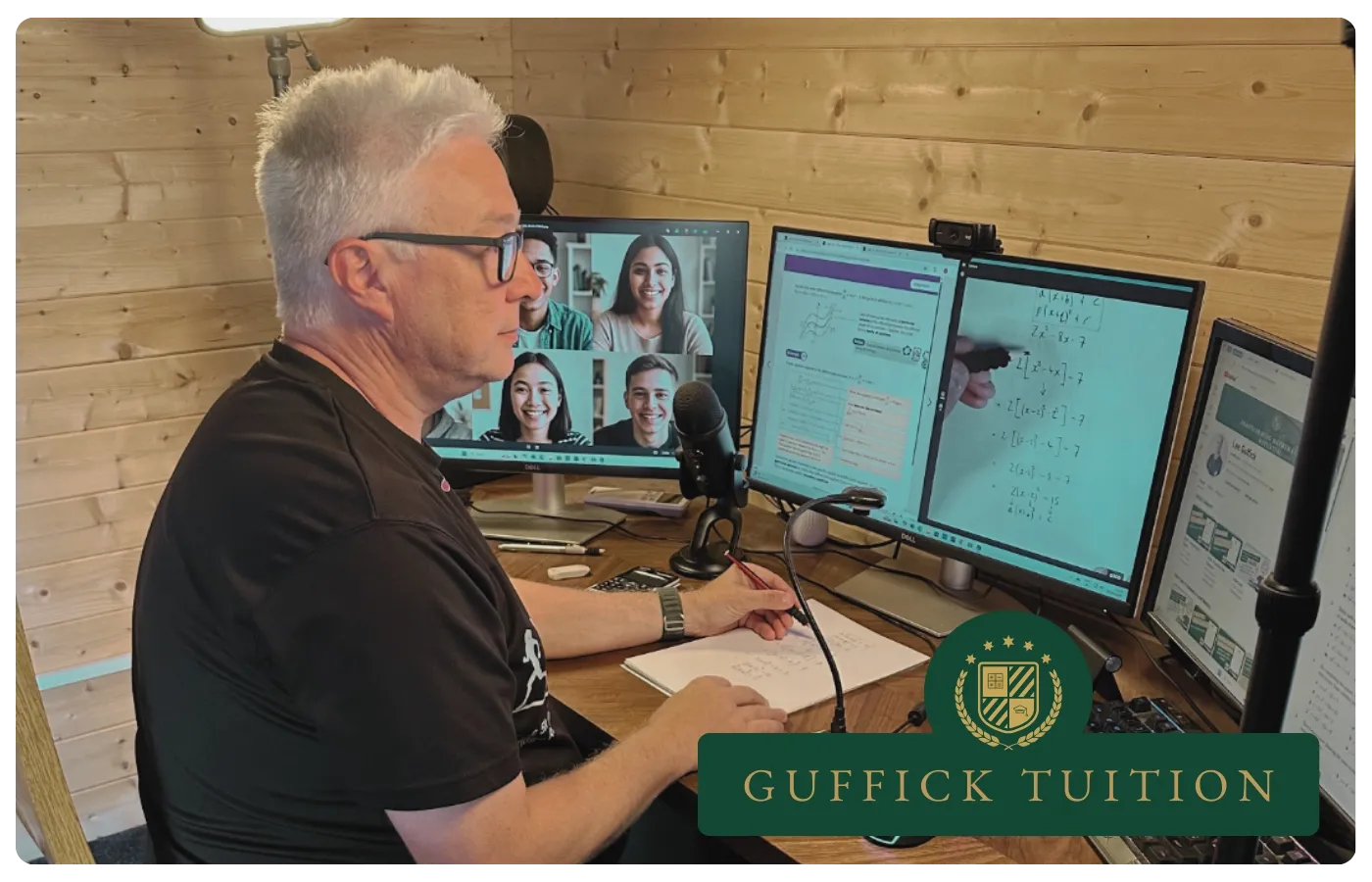
This is not drop-in homework help. It is a structured, curriculum-aligned programme that completes the full Year 13 course ahead of the school's pace, following the Edexcel A-Level Maths specification — with the hardest topics introduced early, when there is still time to master them.
The first Year 13 group for September is full. This page is for the second group — capped, like every group, at 10 students.
The Cost & What Your Child Gets:
£110
per week for both sessions. No sign-up fees. No long-term contracts. Cancel at any time.
Message me on WhatsAppMeet Your Tutor – Experience You Can Trust
I'm Lee Guffick — a former Head of Mathematics at a leading independent school, with experience teaching students from schools including Eton College, Westminster School, Brighton College, and Dulwich College. My fifteen-year classroom career has spanned both state and independent settings.
I hold an MA (Distinction) in Educational Innovation with a specialism in Mathematics from the University of Warwick. I am also an active A-Level Maths examiner — marking exam scripts every summer means I see the same gaps come up year after year, and that observation directly shapes how I teach. I'm a Hays Education Award winner.
I've helped hundreds of students achieve results they didn't think were possible. But more importantly, I've helped students who had given up on maths rediscover that they can do it — they just needed the right support.
I am an active teacher at a leading independent school in the West Midlands and I am fully DBS-checked. Nothing makes me happier than seeing a young person who once said "I'm just not good at maths" go on to ace their A-Level exams.


Abdul — Year 13
"Before I started tuition with Lee, I was really struggling with maths at A level. Not just pure but mechanics and stats too, and I was getting in the 40s (around a D) in pure maths in my year 13 November mocks. After a few months of tuition I was able to get 89/100 in my most recent January maths paper 1 mock. I have also improved at stats and mechanics. I truly recommend Lee as he is a great person and tutor and will 100 percent up your grade."
A Sklinitzis
“Lee is a great tutor. He demonstrates a passion for his subject and has an engaging teaching style. Through a combination of group teaching and one to one sessions Lee supported two of my sons to achieve very high grades at A Level. Both were predicted C grades to start with, and finished up significantly better. The sessions are organised and time is managed well to deliver results. Both sons have gone on to secure their first choice at University. The proof is in the results. Difficult maths is conveyed clearly and simply and the boys seemed to progress quickly. Lee is a master class in how to deliver online tuition.”
Ethan
“I had Lee for 3 years through Year 11 to Year 13 and he has been a major help from improving my Maths ability. He helped build my confidence in a relaxed and collaborative environment with the sessions being led mostly by what I wanted to cover. I felt I could ask any questions no matter how trivial or silly they initially seemed and I was always met with an insightful and tailored response to my exact issue. Lee is punctual and very reliable with no last minute cancellations. He gives suggested work to complete between sessions aimed at your weaker areas so be prepared to put the work in to make the most of this incredible tutor. He helped me get an A* in Maths and aided me in getting into my chosen university.”
Lucy
“Lee is an impressive and intuitive tutor. Within a few short moments my daughter was engaged in a wonderful dialogue with Lee based on trust and confidence in his ability. 4 sessions in and we're in it for the long haul; my daughter proactively prepares for her lessons and independently references what she has been studying with Lee. Lee has given my daughter the spring back in her step and it is amazing to see her belief in herself return. Lee's innate ability to connect with students coupled with his professionalism have surpassed any expectations. Thank you so much! ”
Don't just take my word for it. See what parents say on: Trustpilot (30+ reviews)
How to Get Started
STEP 1
Send me a message on WhatsApp or book a free 10-minute call. Tell me a bit about your child and where they're finding things difficult.
STEP 2
After a brief conversation to make sure the programme is the right match, your child joins the next available Monday session. No formal assessments or application forms — just a sensible check that we're a good fit for one another.
STEP 3
Within a few weeks, you'll see the difference — in your child's understanding, their confidence, and how they approach the kinds of problems they would have walked away from before.
Common Questions
What if Year 12 didn't go to plan — can they still aim high?
What technology do they need?
What if they miss a session?
How will I know my child is making progress?
Is there a minimum commitment?
How does the group programme compare to one-to-one tutoring?
Can my child also have 1:1 sessions?
My child does AQA/OCR, not Edexcel — does that matter?
How does this help with UCAS predicted grades?
Can we join later in the year?
Not Ready to Get in Touch Yet?
Start Here.
I've written a short guide for parents of Year 13 students — covering how predicted grades are decided this autumn, the two topics that carry a disproportionate share of the final marks, and why the students who finish with the top grades are the ones who start September ahead, not the ones who catch up after mocks. It's free, and it's yours in 30 seconds.